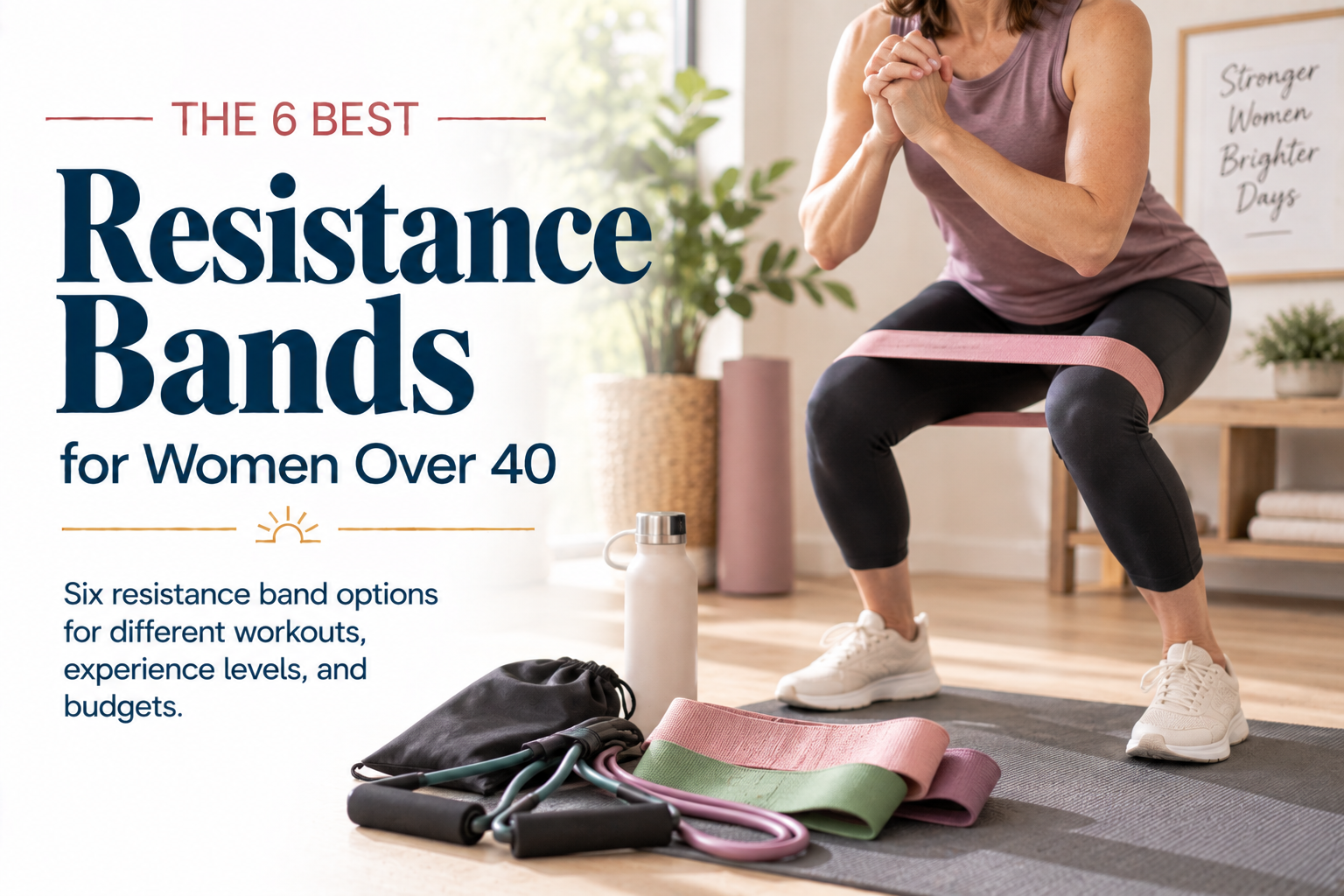
Six resistance band options for different workouts, experience levels, and budgets
Affiliate disclosure: This article may contain affiliate links. If you make a purchase through one of these links, we may earn a commission at no additional cost to you.
Resistance bands are one of the simplest ways to add strength training at home. They’re compact, relatively inexpensive, and can be used for everything from lower-body exercises to rows, presses, and full-body workouts.
But choosing a set can get confusing quickly. Mini loops, fabric bands, long loops, flat bands, and tubes with handles are all called resistance bands even though they work quite differently.
If you’re starting or rebuilding a strength routine after 40, you don’t need a special band because of your age—or automatically need the lightest resistance. What matters is choosing the right type for the exercises you want to do, using resistance you can control, and having room to progress.
We researched six different options so you can choose based on how you actually want to exercise.
Our Quick Picks
| Best for | Our pick | Why choose it |
|---|---|---|
| Best overall | Bodylastics 6-Band Pro Series | Versatile full-body system |
| Best fabric bands | Bala Bands | Comfortable loops for lower-body workouts |
| Best budget | Fit Simplify Resistance Loop Exercise Bands | Five levels at a low price |
| Best for beginners | THERABAND Resistance Band Set | Simple progressive flat bands |
| Best for strength progression | Serious Steel 41-Inch Resistance Bands | Broad resistance range |
| Best with handles | WHATAFIT Resistance Bands Set | Simple, familiar grip |
How We Chose
We compared current manufacturer information with independent product testing and research, looking at band type, resistance options, versatility, construction, ease of use, portability, progression potential, and Amazon availability.
We did not personally test every resistance band in this guide, and we don’t claim that we did.
We also deliberately selected different band styles rather than recommending six nearly identical sets.
1. Bodylastics 6-Band Pro Series — Best Overall
Why We Picked It
Bodylastics is our strongest overall choice if you want resistance bands to play a significant role in your home strength workouts.
The system includes six resistance tubes along with handles, ankle straps, anchors, and a carrying bag. The bands can also be combined, giving you considerably more exercise and resistance options than a basic set of mini loops.
That versatility is its biggest advantage: instead of buying separate bands for different types of exercises, you get one compact system capable of handling a broad range of upper- and lower-body movements.
Pros
- Excellent full-body versatility
- Six stackable resistance bands
- Handles, ankle straps, and anchors included
- Plenty of room to progress
Cons
- More equipment than you need for simple lower-body exercises
- Requires more setup than basic loops or flat bands
Choose this if: You want one versatile resistance-band system for full-body home strength training.
2. Bala Bands — Best Fabric Bands
Why We Picked Them
If you primarily want bands for lower-body exercises and prefer the feel of wider fabric loops, Bala Bands are the standout option.
The set includes three woven-fabric loops in light, medium, and heavy resistance levels. Their wider construction makes them particularly well suited to glute and hip exercises, Pilates-style workouts, and other lower-body movements.
They’re also compact enough to keep in a drawer or pack for travel.
Pros
- Comfortable woven-fabric construction
- Three resistance levels
- Compact and portable
- Particularly useful for lower-body exercises
Cons
- Primarily designed for lower-body use
- Less versatile for rows, presses, curls, and full-body training
Choose this if: You mainly want comfortable fabric loops for lower-body workouts, Pilates, or general home exercise.
3. Fit Simplify Resistance Loop Exercise Bands — Best Budget
Why We Picked Them
Fit Simplify offers an inexpensive way to find out whether resistance bands will actually become part of your routine.
The set includes five small loops ranging from extra-light to extra-heavy resistance, plus a carrying bag. There is almost no setup involved: choose a resistance level and start your exercise.
They’re not a complete strength-training system, but that’s not what they’re trying to be. Their combination of simplicity, portability, multiple resistance levels, and low cost makes them an easy entry point.
Pros
- Very affordable
- Five resistance levels
- Extremely compact
- Simple to use
Cons
- Small loops limit exercise variety
- Not a substitute for a more complete full-body band system
Choose this if: You want an inexpensive set of basic resistance loops without making a big investment.
4. THERABAND Resistance Band Set — Best for Beginners
Why We Picked It
THERABAND is our beginner choice because it strips resistance-band training down to the basics.
Instead of loops or tubes with accessories, the set uses three long flat bands with progressively higher resistance. You can hold, wrap, or position them in different ways without dealing with handles, anchors, or complicated equipment.
They’re particularly useful for controlled resistance exercises, mobility work, and gradually introducing resistance training.
Pros
- Very simple design
- Three progressive resistance levels
- Lightweight and portable
- Useful for controlled movements and mobility work
Cons
- No handles
- More limited progression than heavier band systems
Choose this if: You’re new to resistance-band exercise and want something simple and manageable.
5. Serious Steel 41-Inch Resistance Bands — Best for Strength Progression
Why We Picked Them
Serious Steel is the better choice if you’re already exercising and want resistance bands that can continue challenging you as you get stronger.
These are long continuous loops rather than small lower-body bands. Serious Steel offers a particularly broad range of resistance options, making the bands useful for strength-focused movements such as rows, presses, hinges, squats, and assisted exercises.
You don’t need the heaviest bands. The advantage is having the ability to start at an appropriate resistance and move up later.
Pros
- Broad resistance range
- Excellent progression potential
- Versatile long-loop design
- Useful for full-body strength exercises
Cons
- Less intuitive for complete beginners
- Heavier resistance options will be unnecessary for many home exercisers
Choose this if: You already exercise and want long-loop bands with plenty of room for strength progression.
6. WHATAFIT Resistance Bands Set — Best With Handles
Why We Picked Them
If you don’t enjoy gripping bare resistance bands, WHATAFIT offers a straightforward alternative.
The set includes five resistance tubes with handles, making movements such as rows, curls, and presses feel more familiar if you’re accustomed to dumbbells or cable equipment.
The bands can be stacked for additional resistance, and the set also includes ankle straps and a door anchor. That gives you more exercise options while still keeping the system compact and easy to use at home or while traveling.
Pros
- Easy-to-grip handles
- Five resistance levels
- Bands can be stacked
- Door anchor and ankle straps included
Cons
- More setup than simple loop bands
- Less suitable if you specifically want flat or fabric bands
Choose this if: You want versatile resistance tubes with handles for familiar strength-training movements.
Resistance Band Comparison
| Product | Type | Best for | Progression | Setup |
|---|---|---|---|---|
| Bodylastics 6-Band Pro | Tubes + handles | Full-body training | Excellent | Moderate |
| Bala Bands | Fabric loops | Lower body | Moderate | Very easy |
| Fit Simplify | Mini loops | Budget/basic workouts | Moderate | Very easy |
| THERABAND | Flat bands | Beginners | Moderate | Easy |
| Serious Steel | Long loops | Strength progression | Excellent | Moderate |
| WHATAFIT | Tubes + handles | Handle-based workouts | Good | Easy |
How to Choose Resistance Bands
Choose the Right Band Type
The type of band matters more than the brand.
Mini loops are useful for glute and hip exercises, warm-ups, and lower-body workouts.
Fabric loops perform similar jobs but offer a wider fabric construction.
Flat bands are simple and versatile for controlled resistance and mobility work.
Long loops offer considerably more exercise variety and progression potential.
Tube bands with handles can make rows, curls, presses, and other familiar strength exercises easier to grip.
Don’t Automatically Choose the Lightest Resistance
There is no resistance level that every woman over 40 should start with.
The appropriate resistance depends on the exercise, your current strength, experience, and ability to control the movement.
Choose enough resistance to make the exercise challenging while still allowing you to maintain good form. Having several resistance levels is useful because you may need different resistance for different exercises.
Resistance ratings also aren’t perfectly standardized between manufacturers, so don’t assume the same number will feel identical across brands.
Think About Progression
A resistance band that’s challenging today may eventually become too easy.
If strength is your goal, look for a set that lets you progress by using stronger bands, combining bands, increasing stretch, or moving to more challenging exercise variations.
This is one reason sets with several resistance levels can be more useful than buying a single band.
Consider How Much Setup You Want
Simple loops and flat bands can be used almost immediately.
More elaborate systems with handles, door anchors, and ankle straps take slightly longer to set up but give you considerably more exercise options.
Neither approach is inherently better. Choose the one you’re actually likely to use consistently.
Inspect Your Bands Regularly
Resistance bands can wear over time.
Check for cracks, tears, thinning, fraying, or other visible damage before using them, particularly around areas that are frequently stretched or attached to anchors.
Follow the manufacturer’s instructions for using and anchoring the bands, and replace visibly damaged equipment.
Frequently Asked Questions
Can Resistance Bands Build Strength?
Yes. Resistance bands can provide meaningful resistance and become progressively more challenging through stronger bands, greater stretch, combined bands, or harder exercise variations.
The important factor is continuing to challenge your muscles as you become stronger.
Are Resistance Bands Enough for Home Strength Training?
They can be a significant part of a home strength routine, particularly if you have multiple resistance levels and a versatile band style.
However, bands and dumbbells provide resistance differently. Bands become more resistant as they stretch, while dumbbells provide a fixed external weight.
You don’t necessarily have to choose between them. They can complement each other well in a home workout setup.
Are Fabric Resistance Bands Better Than Latex Bands?
Not necessarily.
Fabric loops can feel comfortable and work particularly well for lower-body exercises. Elastic bands are available in more formats, including long loops, flat bands, and tubes.
Choose based primarily on the exercises you want to perform.
How Long Do Resistance Bands Last?
There isn’t one replacement schedule that applies to every band.
Wear depends on the material, frequency of use, storage, and how the bands are used. Inspect them regularly and replace bands showing cracks, tears, thinning, fraying, or significant deterioration.
Bottom Line
The best resistance band isn’t necessarily the biggest set or the one with the highest resistance. It’s the one that fits the way you actually plan to exercise.
For the broadest home strength setup, Bodylastics 6-Band Pro Series is our best overall choice because of its versatility and progression potential.
If you want something simpler, choose the band style that matches your workouts—whether that’s comfortable fabric loops, inexpensive mini bands, beginner-friendly flat bands, long loops, or tubes with handles.
Start with resistance you can control and leave yourself room to progress.